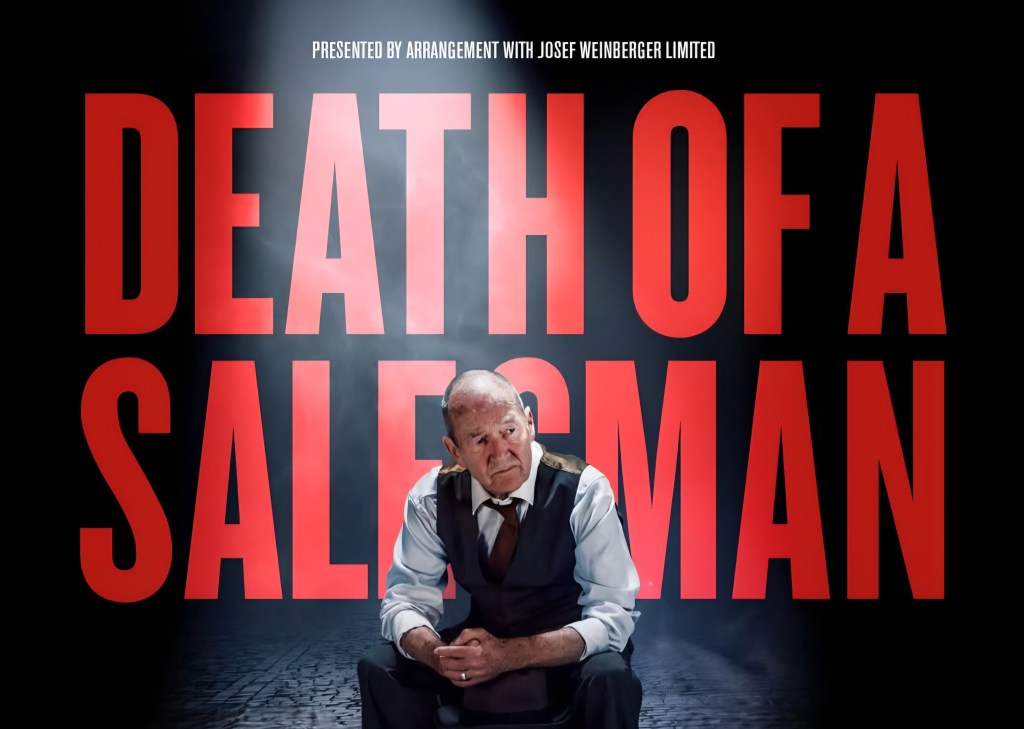
Strong cast tackles self-deception, masculinity, and the American Dream in this eerily relevant play
Death of a Salesman has been staged, filmed, adapted for radio, and reimagined countless times. It won the Pulitzer Prize for Drama and the Tony Award for Best Play in 1949. Its playwright, Arthur Miller, described it as a “tragedy of the common man”, which is why it has continued to resonate with audiences for decades.
A plethora of actors have incarnated Willy Loman, the main character of the play, over the years. Comedian and TV host John Mulaney recently brought together 11 of those actors, including 86-year-old Christopher Lloyd, to talk about the character and reenact its most iconic scene in a testament to its longevity.
In brief, it was up to Andy Arnold, the director of the adaptation, David Hayman, Loman’s interpreter and the rest of the cast, to create a version of the play which would speak to modern audiences without feeling redundant; a task which they mostly succeeded at, in this restrained but impactful production.
The play was performed at the Lowry Theatre in Manchester, a city with a strong corporate and sales culture (a former salesman myself, the play connected with me at my core, seeing a future that could have been) — presented on a simple yet effective stage.

David Hayman as Willy Loman
Seasoned Scottish actor David Hayman portrays Loman with sincerity and depth. His Brooklyn accent, playfully exaggerated to near perfection, brings authenticity to the role. Willy Loman is a complex character to embody, with his mood shifting from moments of jubilation in dementia-induced flashbacks to deep melancholy when he moves back to reality.
Hayman’s portrayal is in tune with Miller’s description: a character full of self-deception, tricked by the idea of the American Dream—an idea brought to life by Stewart Ennis, who portrays Loman’s brother Ben, a man who chased gold and found wealth, who Willy Loman idolises as the definition of success.
The chase of the American Dream is a concept that looms over the play and its three leading characters, Loman and his two sons, Biff and Happy, portrayed by Daniel Cahill and Michael Wallace respectively. Loman desperately wants to be well-liked but confuses popularity with material success, Biff struggles to leave the idea of the Dream behind and Happy’s shallow views have him convinced he is living it. All three actors effectively bring this shared confusion to life, in ways that are sure to resonate with the audience.
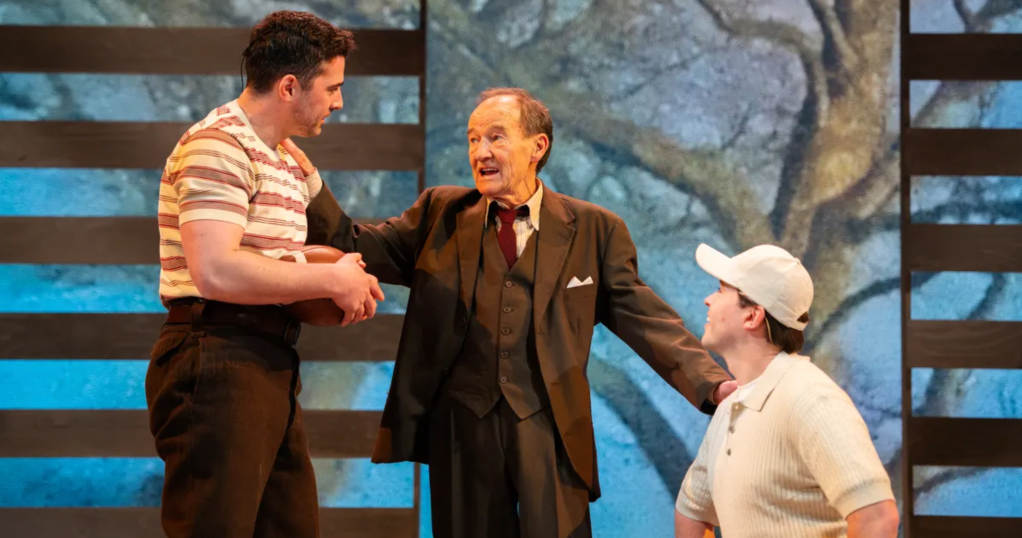
Hayman as Willy Loman, with Cahill as Biff and Wallace as Happy — his onstage sons
It would be a significant omission to not mention Beth Marshall, who plays Linda Loman, Willy’s burdened wife, in this adaptation. While she is not given much to play with in terms of dialogue – the play focuses on the relationship between Loman and his sons for the most part – Marshall captures Linda’s loyalty with a restrained but quietly powerful performance.
Hayman described the play as “a true masterpiece—raw, timeless, and deeply moving”, and while this interpretation does not push the boundaries of theatrical innovation, it successfully portrays the key themes of Miller’s work, accompanied by a strong main cast and a compelling supporting ensemble. Its bleak tone and strong messages did not necessitate Arnold to reinvent the play; he and the cast did a wonderful job of creating a tense atmosphere, bringing some strong (if rare) laughs and, more importantly, making the audience reflect on what it truly means to chase success.
 Chronicles of a thematic drifter
Leave a comment