
Spectacle carries an uneven adaptation
The Hunger Games: On Stage is brought to life under the direction of Matthew Dunster at the newly opened Troubadour Canary Wharf Theatre. The play is directly inspired by the work of Suzanne Collins, the author of the original novels. It opened towards the end of 2025 to mixed reactions during its preview period, with reports of technical difficulties during early performances. Those issues are now resolved, but the production still carries traces of an identity problem, never quite settling on what kind of stage adaptation it wants to be.
I attended a daytime performance, a detail that feels relevant given the intense physical demands placed on the cast. The show relies heavily on stunts, fight choreography and technical effects, and it is difficult not to admire the sheer endurance required of the young performers who would have to do it all over again in the evening.
The actors are required to act, sing and perform complex stunts, and while the overall level of acting is inconsistent, including some shaky American accents, the energy they bring to the floor keeps the production engaging.
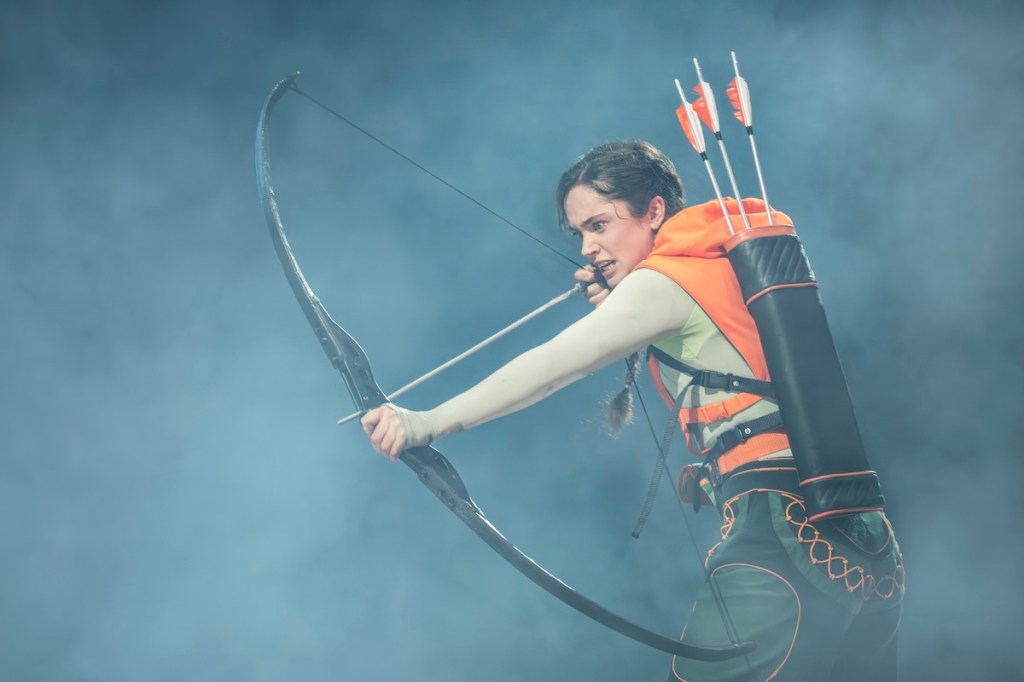
Mia Carragher leads the cast as Katniss Everdeen and delivers a strong performance. The play’s use of fourth-wall breaking internal monologue allows her to showcase her acting skills, even though the sequences could easily have felt intrusive. Her co-star Euan Garrett is convincing as Peeta Mellark, even when the script gives him limited space to develop.
The standout performance comes from Joshua Lacey as Haymitch Abernathy. His portrayal carries clear echoes of Woody Harrelson’s film performance without being a carbon copy. Lacey brings gravitas and playfulness to the role that makes Haymitch one of the most compelling figures on stage.
John Malkovich’s involvement as President Snow is a notable selling point of the play, but the less-informed audiences may be surprised to learn that he appears only via pre-recorded sequences on screens. His delivery feels slightly disconnected, possibly due to overdrawn pauses designed to avoid dialogue overlap with the live performers, leaving Malkovich more as a cameo than an active antagonist.
There are pacing issues in the first act, particularly as the production builds toward the arena, but it finds its rhythm once the Games begin. The second act is where the production feels most confident, leaning into choreography, spectacle and technical ambition to deliver an engaging adaptation.
The play truly succeeds in its impressive stage production. It must be noted that the Troubadour theatre was built specifically for the show, and it manages to distance itself from existing venues in London with its many technical gimmicks. Smoke machines, pyrotechnics, moving climbing nets and many more effects add a layer of spectacle throughout the play.
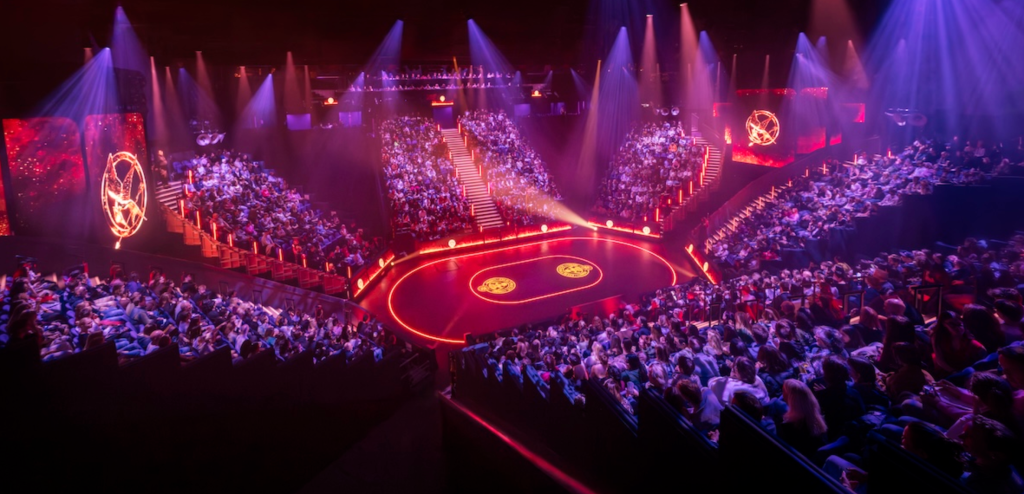
The stunts are consistently impressive, from fights along vertical surfaces to performers descending from lighting rigs used as makeshift trees. The moving set, combining mechanical shifts with actor-driven scene changes, allows for large seamless transitions.
Sound is also used heavily throughout, from pre-recorded effects to physical, animalistic movement from the cast, and largely avoids becoming distracting.
The musical elements are where the uncertainty of tone is most apparent. The first musical number feels oddly placed and disrupts the flow of the opening act rather than enhancing it. A later musical sequence, following the death of one of the Tributes, transports the audience to the lavish world of District 1. The intention to contrast the brutality of the Games with the excess of the richer district is clear, but the execution feels awkward, pulling focus away from the emotional weight of the moment. At times, it feels as though Matthew Dunster wanted to stage a Hunger Games musical and ultimately settled for inserting parts of that idea into the play.
The seating plan is cleverly divided between the districts, one to twelve as taken from the source material, with two of the districts functioning as moving set pieces themselves. While this is an ingenious idea, it risked becoming repetitive over time, especially for those sitting in those rows. The shifts were also distracting at times, with the noise of the moving parts occasionally intruding on heavier scenes, which is a shame as these moments might have allowed the cast’s acting to come through more clearly.
The play could have benefited from a deeper dive into its dystopian setting and a more focused tone, but it delivered a strong spectacle which will entertain even those with little to no knowledge of Suzanne Collins’ original work.
 Chronicles of a thematic drifter
Leave a comment